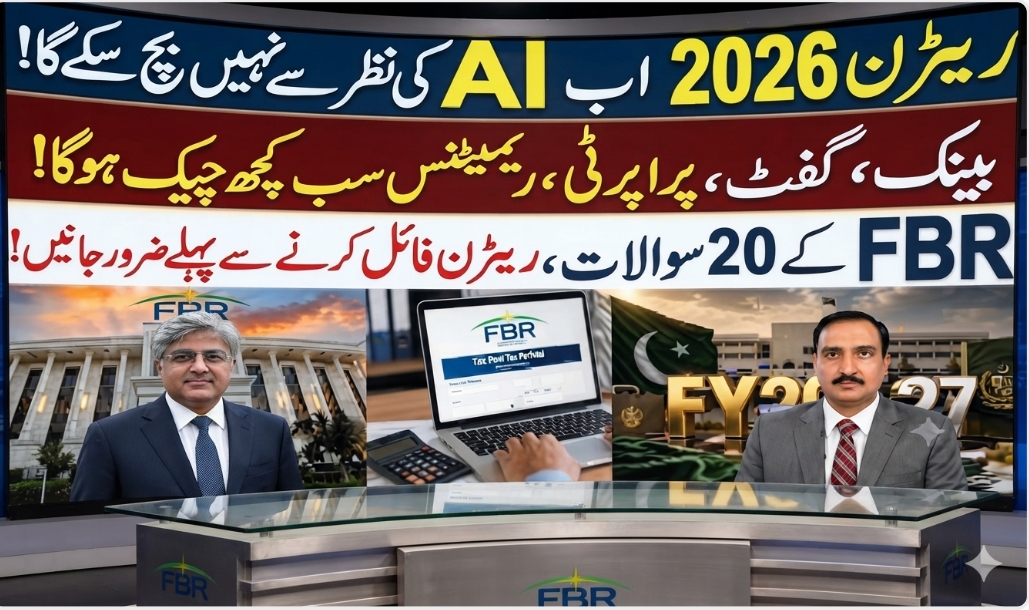
- FBR artificial intelligence tax returns
- Income tax return filing Pakistan
- FBR bank statement reconciliation
- Section 85 gift tax income tax law
- Section 39 cash loan income tax
- Section 68 fair market value property
- Foreign remittance tax exemption Pakistan
- FBR CNIC profile matching
Introduction
The Federal Board of Revenue (FBR) is formally initiating the use of Artificial Intelligence (AI) to detect errors and undisclosed income in income tax returns filed for Tax Year 2026. This technological shift has caused widespread concern among Pakistani taxpayers, business owners, and professionals who are uncertain about how the new system will impact their filings.
The implementation of AI does not mean taxpayers need to panic, nor does it eliminate the role of professional tax guidance. Instead, it changes how tax returns are reviewed. This article explains how the FBR’s modern computer systems use Computerized National Identity Cards (CNICs) to cross-match financial records, including bank transactions, property dealings, and card expenditures. Readers will learn practical compliance steps, including bank reconciliation, legal requirements for gifts and loans, foreign remittance provisions, and new reporting requirements for property income.
How the FBR AI System Works
The FBR’s AI initiative relies on modern computer processing to build a comprehensive financial profile of each taxpayer using their CNIC.
1. Data Aggregation
The FBR already possesses extensive financial data regarding taxpayers, including:
- Bank account inflows and outflows.
- Property purchase and sale records.
- Debit and credit card usage.
2. Automated Cross-Matching
The AI system automatically compares declared income on tax returns against actual expenses and bank transactions.
- System Red Flags: If a bank account receives substantial funds during the year—such as 500 million rupees—while the account holder pays a disproportionately low amount of tax (e.g., 10,000 rupees), the system instantly generates an automated red flag.
The primary objective of the AI system is to identify individuals who have vast discrepancies between their actual expenses/inflows and their declared income, thereby targeting tax evasion.
Key Compliance Requirements for Taxpayers
To avoid legal notices and penalties from automated AI flags, taxpayers must maintain complete records and follow specific statutory procedures.
1. Preparing Bank Reconciliations
A crucial step before filing an income tax return is performing a thorough bank reconciliation. Taxpayers and consultants must match annual bank statements with declared income to segregate non-taxable receipts.
- Example – Asset Sales: If a taxpayer sells a personal property or asset for 100 million rupees, the deposited amount increases the bank balance. Legally, this 100 million rupees is an asset sale receipt, not taxable business income. Without bank reconciliation, the AI system may flag the deposit as undeclared sales or income and generate a notice.
- Non-Taxable Inflows: Other non-taxable funds that must be properly documented and separated in bank statements include:
- Legitimate loans received through banking channels.
- Legal gifts.
- Foreign remittances.
Legal Provisions for Specific Transactions
Foreign Remittances
Under the Income Tax Law, foreign remittances received from abroad are protected under specific conditions:
- Exemption Threshold: If an individual receives up to 5 million rupees from abroad through legal banking channels, the FBR will not inquire about the sender’s identity or the source of funds.
- Mandatory Condition: The remittance must enter Pakistan strictly through legal banking channels.
Gifts and Section 85
Taxpayers frequently make errors when reporting gifts. Section 85 of the Income Tax Law establishes strict provisions regarding gift transactions:
- Definition of Relatives: Legal gifts are restricted strictly to specified family members:
- Parents
- Grandparents
- Children
- Spouse
- Payment Method: Gifts must be executed via crossed cheque. Cash gifts are not recognized by the FBR.
- Documentation & NTN Requirements:
- The donor must have a legitimate source of income and declare the financial outflow in their tax return.
- The recipient must declare the financial inflow in their tax return.
- Both the donor and recipient must be NTN holders.
Loans and Section 39
When borrowing money from an individual:
- Mandatory Banking Channel: The loan must be received through a crossed cheque.
- Tax Penalty on Cash Loans: If a loan is taken in cash, the FBR will treat the entire amount as taxable income under Section 39 of the Income Tax Law and levy heavy taxes.
New Reporting Rules for Property Income (Section 68)
The FBR has introduced detailed reporting requirements for property income in tax returns for the current year.
Mandatory Property Details Required:
- Exact physical location of the property.
- Property measurements/size.
- Classification (Commercial or Residential).
Fair Market Value Checks
The AI system uses this detailed information to evaluate declared rental income under Section 68 of the Income Tax Law:
- The system checks whether the declared rental income aligns with the fair market value of the specific area.
- Taxpayers can no longer report rental rates for high-value locations (such as Defence or Gulberg) that match rates in ordinary areas. Declaring undervaluation leads to heavy penalties.
Action Plan for Taxpayers
To ensure full legal protection and prevent automated notices:
- Maintain Complete Records: Keep documentary evidence for every large bank transaction, including property sale agreements, crossed cheques for loans, and gift documentation from parents.
- Review Historical Filings: Retrieve and inspect previous years’ tax statements prior to submitting new returns.
- Declare Accurate Figures: Taxpayers who truthfully disclose actual income and genuine expenses will not face issues from the AI system.
- Seek Professional Advice: Consult a qualified tax lawyer to navigate legal complexities and protect hard-earned assets before filing returns.
Frequently Asked Questions
Question: What is the primary function of the FBR’s new AI system for Tax Year 2026?
Answer: The AI system cross-matches a taxpayer’s declared return with their CNIC-linked financial profile, including bank transactions, property purchases/sales, and card expenditures, to detect errors and hidden income.
Question: Is a 100 million rupee bank deposit from a property sale taxable as business income?
Answer: No. Funds received from selling personal property represent an asset transaction rather than business income. However, a bank reconciliation and documentary proof are required so the AI system does not flag it as taxable sales.
Question: What is the maximum limit for foreign remittances exempt from source inquiries?
Answer: Up to 5 million rupees received from abroad through legal banking channels is exempt from inquiries regarding the sender or source of funds.
Question: Who qualifies as a “relative” for tax-exempt gifts under Section 85?
Answer: Under Section 85 of the Income Tax Law, a relative is strictly limited to parents, grandparents, children, and a spouse. Both parties must hold NTNs, and the transaction must be made via crossed cheque.
Question: What happens if a loan is received in cash instead of a crossed cheque?
Answer: If a loan is taken in cash, the FBR does not recognize it as a valid loan and treats the amount as taxable income under Section 39, subjecting it to heavy taxes.
Question: How does the AI system check rental income under Section 68?
Answer: The system uses declared property location, size, and type (commercial/residential) to verify whether the reported rent matches the fair market value of that specific area under Section 68.
Conclusion
The implementation of Artificial Intelligence by the FBR for Tax Year 2026 automates the verification of income tax returns against real-world financial transactions. Rather than fearing the technology, taxpayers can ensure full compliance by maintaining accurate documentation, conducting bank reconciliations, following banking channel rules for gifts and loans, and properly reporting property details. Understanding these legal provisions safeguards fundamental rights, prevents disturbing notices, and protects businesses from heavy penalties.
Call to Action
Stay informed on changing tax regulations to safeguard your business and personal assets. Read our related tax and legal articles to learn more about Pakistani compliance laws, subscribe to the YouTube channel for regular video updates, leave your tax questions in the comments section below for future Q&A coverage, or reach out to professional tax consultants for expert assistance.
Professional Author and Contacts information
Chaudhry Muhammad Saeed, Advocate High Court Senior Member, High Court Bar Association Lahore Jinnah Tax Lawyers
- Services: Professional association of lawyers, chartered accountants, computer engineers, and AI experts providing services in property disputes, study abroad & immigration services, income tax, sales tax, company registration, NTN registration, refund claims, SECP, and FBR matters.
- Phone: 0300-342597
- Email: ms-saeed-adv@gmail.com