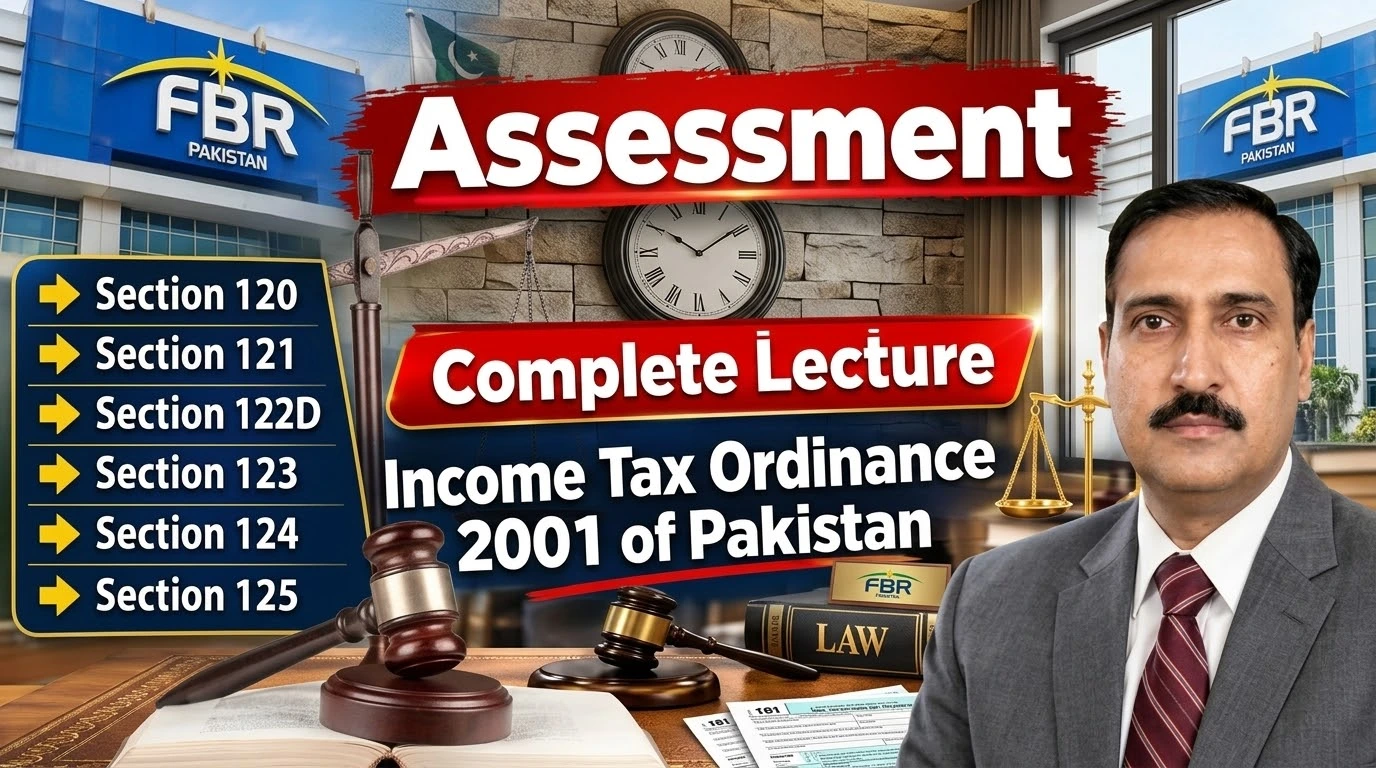
Learn how FBR assesses income tax returns under Sections 120 to 125 of the Income Tax Ordinance. Understand best judgment assessments, audits, and notices.
Filing an income tax return with the Federal Board of Revenue (FBR) is a key responsibility for taxpayers, small shopkeepers, and business owners across Pakistan. However, many taxpayers are unaware of what happens after their return is submitted and how FBR finalizes their tax assessment.
Understanding the legal mechanism behind tax assessment is essential for every taxpayer to maintain compliance and avoid unnecessary notices, ex-parte decisions, or legal complications. Under the Income Tax Ordinance, Sections 120 through 125 govern how returns are processed, how audits are conducted, how FBR assesses non-filers, and how assessment orders can be amended or revised following appeals and court decisions.
Normal Assessment and System Acceptance (Section 120)
When a taxpayer completes and files their income tax return with FBR, the system automatically accepts it. Upon acceptance, the return itself is legally treated as the assessment order. This means that FBR initially accepts the tax calculations and financial details as declared by the taxpayer.
Deficiency Notices and FBR Audits
Automatic acceptance does not mean the return cannot be questioned. If the Commissioner detects any deficiency in the filed return, a notice can be issued to the taxpayer within 180 days from the end of the relevant financial year.
- Resolving Deficiencies: If the taxpayer provides a proper response to the notice within the specified timeframe, the assessment process is completed.
- Tax Audit: FBR also retains the authority to conduct an audit of the taxpayer’s return. During an audit, the taxpayer may be required to provide documentary proof of their reported income and claimed business expenses.
Best Judgment Assessment for Non-Filers (Section 121)
If a person fails to file their income tax return altogether, FBR applies Section 121, known as a Best Judgment Assessment.
Under this provision, the Commissioner issues an assessment order based on whatever information is available to FBR regarding the individual’s income and assets.
- Time Limit: The Commissioner can pass a Best Judgment Assessment order at any time within 5 years of the tax year in which the return was due to be filed.
Amendment in Assessment (Section 122)
An assessment order—whether issued automatically under Section 120 or assessed directly—can be modified under Section 122 if new evidence comes to light.
Triggers for Amendment
If the Commissioner obtains definite information showing that a taxpayer has concealed income or wrongly claimed expenses, the previous assessment order can be amended within 5 years.
Procedural Safeguards
Before amending an assessment, FBR must adhere to the principles of natural justice:
- The taxpayer must be given an opportunity of being heard.
- The Commissioner must issue at least three notices, with each notice providing a 15-day period for a response.
Agreed Assessment (Section 122D)
To settle disputes amicably without prolonged litigation, a taxpayer can submit an offer of settlement. If accepted, this leads to an agreed assessment under Section 122D, effectively resolving the matter.
Provisional Assessment and Undisclosed Assets (Section 123)
If an undisclosed property or asset comes to light that was not declared in the taxpayer’s filings, the Commissioner can issue a provisional assessment order under Section 123.
- Response Window: The taxpayer is granted 30 days to respond to the provisional assessment order.
- Protection under the 2019 Amnesty Scheme: Taxpayers who declared their previously undisclosed assets under the 2019 Tax Amnesty Scheme and paid the prescribed minimum tax are protected by law. No further proceedings can be initiated against those specific declared assets.
Assessment Following Appeals and Court Decisions (Sections 124 & 125)
The assessment process may also be affected by appellate decisions or legal disputes handled in civil courts.
| Section | Scenario | Timeline for FBR Action |
|---|---|---|
| Section 124 | An Appellate Tribunal or High Court rules in favor of the taxpayer or directs a fresh assessment. | The Commissioner must pass a new assessment order within 1 year of the decision. |
| Section 125 | A property involved in a tax matter is under dispute in a Civil Court. | Tax assessment on the property is stayed until the court reaches a decision. Assessment must then be completed within 1 year of the final court judgment. |
Practical Takeaways for Taxpayers
To avoid best judgment assessment orders, ex-parte decisions, and unnecessary legal complications, taxpayers should follow these core practices:
- File Returns Timely: Submit accurate income tax returns within the prescribed deadlines.
- Ensure Full Disclosure: Declare all income sources and assets accurately without concealment.
- Respond Promptly to FBR Notices: If FBR issues a notice or audit query, provide a complete, documented response within the given timeframe.
Frequently Asked Questions (FAQs)
What happens immediately after I file my income tax return with FBR?
Under Section 120, your return is automatically accepted by the system upon submission, and the return itself is considered your assessment order.
How long does FBR have to issue a deficiency notice on a filed return?
The Commissioner can issue a notice regarding deficiencies in a filed return within 180 days from the end of the financial year in which the return was filed.
What is a Best Judgment Assessment under Section 121?
A Best Judgment Assessment occurs when a taxpayer fails to file an income tax return. The Commissioner uses available information to assess the taxpayer’s liability and issue an order within 5 years of the return’s due date.
How many notices must FBR send before amending an assessment under Section 122?
Before amending an assessment order under Section 122, FBR must give the taxpayer an opportunity to be heard and send at least three notices, each offering a 15-day response window.
What is an Agreed Assessment under Section 122D?
An agreed assessment allows a taxpayer to end an ongoing assessment dispute by making an offer of settlement to FBR.
Can FBR reopen assets declared under the 2019 Amnesty Scheme?
No. Assets that were properly declared under the 2019 Amnesty Scheme with the minimum tax paid cannot be subjected to further proceedings under Section 123.
What is the deadline for FBR to issue a new assessment after an appeal decision?
If an Appellate Tribunal or High Court orders a new assessment or rules in favor of the taxpayer, the Commissioner must pass the new assessment order within 1 year.
Conclusion
Navigating the tax assessment process under Sections 120 to 125 of the Income Tax Ordinance requires transparency and timely compliance. By filing returns on time, fully declaring all assets and income, and responding promptly to any FBR notices, taxpayers can prevent ex-parte orders and secure their businesses against unnecessary disputes. Accurate reporting remains the most effective defense against legal and financial complications.
Contact & Professional Services
For more detailed guides and updates on Pakistani tax laws, feel free to explore our related tax and legal articles, leave your questions in the comments section below, and subscribe to our channel for future video updates.
Ch. Muhammad Saeed, Advocate High Court Senior Member, High Court Bar Association Lahore
We are an association comprising Lawyers, Chartered Accountants, Computer Engineers, and AI Experts, providing professional services in:
- All legal matters regarding property disputes
- Income Tax & Sales Tax
- Company Registration & SECP matters
- NTN Registration & Refund Claims
- FBR matters
Contact Information:
- Phone: 0341-1259762
- Email: msaeedadv86@gmail.com
Sponsors interested in promoting their products and services are also welcome to reach out.