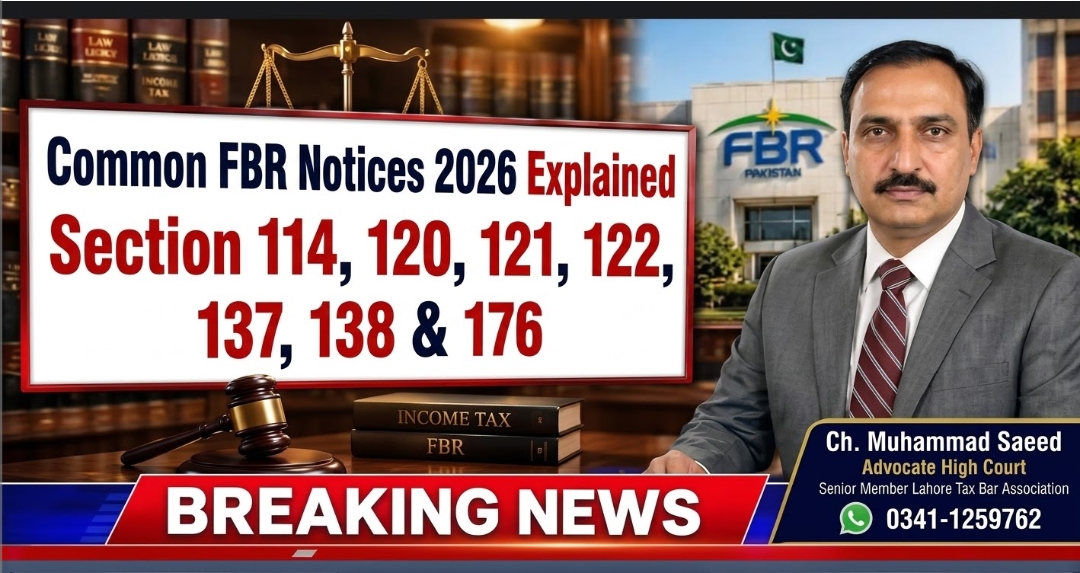
Understand common FBR tax notices in Pakistan, including Sections 114(4), 120(3), 121, 122(5), 122(9), 122C, 137, 138, and 176, and how to respond legally.
- FBR notice response
- Section 114 4 notice to file return
- Section 120 3 deficiency notice
- Section 121 best judgment assessment
- Section 122 5 amendment of assessment
- Section 122 9 show cause notice
- Section 122C provisional assessment
- Section 137 demand notice
- Section 138 recovery notice
- Section 176 notice to obtain information
Introduction
Receiving a notice from the Federal Board of Revenue (FBR) can be a stressful experience for any taxpayer in Pakistan. The mere mention of the FBR often causes panic and anxiety. However, receiving an FBR notice does not mean that a legal case has been finalized against you. Instead, a tax notice serves as an official opportunity to present your side of the story, clarify your position, and submit necessary legal records. Paying taxes is essential for the progress and development of the nation, but understanding your legal rights and obligations is equally important.
This guide breaks down the most common FBR tax notices issued under the Income Tax Ordinance, explaining what each section means, why a notice is issued, and how taxpayers—including business owners, retailers, non-filers, and the general public—should respond in a timely and legal manner.
Notices Related to Tax Returns and Assessment Corrections
Section 114(4): Notice to File Income Tax Return
A notice under Section 114(4) is issued to individuals or entities who have failed to file their income tax returns.
Many taxpayers incorrectly assume that if their income is low or zero, they are not required to file a return. This is a misconception. A Section 114(4) notice acts as a final opportunity from the FBR to file your tax return.
- Consequences of Ignorance: Ignoring a Section 114(4) notice can lead to statutory penalties and may result in a best judgment assessment, which is typically conducted against the taxpayer’s financial interest.
Section 120(3): Deficiency Notice
A Section 120(3) deficiency notice is issued when an income tax return has been submitted, but the tax authority identifies discrepancies or missing details. Common reasons for receiving this notice include:
- Omission of certain income sources.
- Incorrect financial figures or numerical errors.
- Lack of required supporting documents.
It is important to understand that a Section 120(3) notice is not a punishment. Rather, it is an opportunity to correct errors. Correcting and updating your tax return within the stipulated time frame can completely resolve the issue.
FBR Assessment and Amendment Notices
Section 121: Notice Before Best Judgment Assessment
A notice under Section 121 indicates that the FBR intends to assess your tax liability directly. The FBR issues this notice when:
- You have failed to submit a tax return.
- The accounting records and financial documents submitted are deemed unreliable.
Under Section 121, the FBR executes a Best Judgment Assessment, where tax officers estimate your tax liability. Because a best judgment assessment is rarely favorable to the taxpayer, this notice should never be taken lightly.
Section 122(5): Amendment of Assessment
A notice under Section 122(5) is issued when the FBR believes that a previous tax assessment needs to be amended. This generally occurs if the FBR finds that:
- Taxable income was concealed or omitted.
- An incorrect tax exemption or tax credit was claimed.
- The tax paid or declared was lower than the actual liability.
Under Section 122(5), the FBR reserves the authority to amend past assessments. However, taxpayers retain a statutory right to reply to explain their financial position.
Section 122(9): Show Cause Notice
Directly linked to assessment amendments, Section 122(9) serves as a protective notice for the taxpayer. Before the FBR can finalize an amendment to a previous assessment, it must issue a Show Cause Notice under Section 122(9).
This notice provides the taxpayer an opportunity to:
- Explain their legal and financial position.
- Submit accounting records, bank statements, and evidentiary documents.
Filing a proper, legally sound reply to a Section 122(9) notice can successfully prevent an unfavorable tax amendment.
Temporary Tax Assessments for Non-Filers
Section 122C: Provisional Assessment
Section 122C applies specifically to non-filers. Under this provision, the FBR creates a temporary tax demand based on available external records, such as:
- Significant bank transactions.
- Property purchases or asset transfer records.
Although a provisional assessment creates an immediate temporary tax demand, it can be withdrawn if the taxpayer subsequently files their tax return and clarifies their financial position.
Enforcement, Demand, and Recovery Notices
Section 137: Demand Notice
A Section 137 Demand Notice marks the financial enforcement stage of tax proceedings. Receiving this notice means the FBR has formally determined a tax amount payable, which may also include penalties or a default surcharge.
Upon receiving a Section 137 notice, the taxpayer must take one of two actions:
- Pay the assessed tax liability, penalty, or default surcharge.
- Obtain a legal stay against the demand through appropriate legal channels.
Section 138: Recovery Notice
Ignoring a Section 137 Demand Notice leads directly to Section 138, which is the final and most serious recovery stage. If tax dues remain unpaid following a demand notice, a recovery officer is authorized to take direct enforcement actions, including:
- Attachment and freezing of bank accounts.
- Seizure of personal or business property.
- Direct legal action by the recovery officer.
Even at the recovery stage, legal remedies and solutions remain possible, but immediate action is critical.
Information Gathering Notices
Section 176: Notice to Obtain Information
A Section 176 notice is issued purely for information gathering and document verification. Through this notice, the FBR may request specific evidentiary records, such as:
- Bank account statements.
- Proof of foreign income or overseas remittances.
- General business and financial records.
Receiving a Section 176 notice does not mean you are guilty of tax evasion or non-compliance. It is merely a verification exercise. However, failing to comply or failing to provide the requested records can escalate the matter into a serious legal issue.
Summary of Key FBR Notices
| Section | Notice Type | Purpose / Action Required |
|---|---|---|
| 114(4) | Notice to File Return | Final chance to file an income tax return before penalties apply. |
| 120(3) | Deficiency Notice | Opportunity to correct errors, missing income, or figures in a filed return. |
| 121 | Notice Before Assessment | Issued when returns/records are missing or unreliable; leads to Best Judgment Assessment. |
| 122(5) | Amendment of Assessment | Issued when income is concealed or tax is under-declared. |
| 122(9) | Show Cause Notice | Protective notice giving the right to present evidence before an assessment is amended. |
| 122C | Provisional Assessment | Temporary tax demand created for non-filers based on bank or property records. |
| 137 | Demand Notice | Notice establishing payable tax, penalties, or default surcharge. |
| 138 | Recovery Notice | Serious final stage involving bank account attachment or property seizure. |
| 176 | Notice to Obtain Information | Request for document verification (e.g., bank statements, business records). |
Frequently Asked Questions (FAQs)
Question: Does receiving an FBR notice mean a legal case is finalized against me?
Answer: No. An FBR notice is not a final judgment. It is an official opportunity provided by the tax authority for you to explain your position, submit documents, and clear your stance.
Question: Do I need to file a tax return if my income is zero or very low?
Answer: Yes. The belief that low or zero income waives the return filing requirement is incorrect. If you receive a Section 114(4) notice, you are legally required to submit your return.
Question: What happens if I ignore a Section 137 Demand Notice?
Answer: If you ignore a Section 137 Demand Notice without paying or obtaining a legal stay, the proceedings advance to Section 138 (Recovery Notice), which can result in frozen bank accounts and seized property.
Question: Can a provisional assessment under Section 122C be cancelled?
Answer: Yes. A provisional assessment created for non-filers under Section 122C can be withdrawn if you file your income tax return and clear your position with the FBR.
Question: Does receiving a Section 176 notice mean I am guilty of tax evasion?
Answer: No. Section 176 is simply an information-gathering notice used to verify records such as bank statements, foreign income proofs, or business documentation.
Conclusion
FBR notices should not cause panic, but they must never be ignored. Every notice issued by the tax authorities—whether for return filing, document verification, assessment correction, or tax demand—has a specific legal procedure and solution. Timely review of notices, maintaining accurate financial records, and filing proper legal responses are essential to protecting yourself from unnecessary penalties, best judgment assessments, and direct recovery actions like account attachment. Seeking proper legal guidance at the right time ensures your tax rights are protected and your obligations are met efficiently.
Call to Action
For more insights into Pakistani tax regulations, corporate laws, and legal developments, feel free to explore our related articles on income tax, sales tax, property disputes, and SECP compliance. If you have questions regarding an FBR notice you have received, please leave your queries in the comments section below for guidance in future posts. Be sure to follow our YouTube channel, like, share, and subscribe to stay updated on critical tax and legal matters.
Professional & Author Information
Ch. Muhammad Saeed Advocate High Court Senior Member, High Court Bar Association Lahore
Jinnah Tax Lawyers Association A multidisciplinary professional association comprising Lawyers, Chartered Accountants, Computer Engineers, and AI Experts providing legal services in:
- All legal matters regarding property disputes
- Income Tax & Sales Tax
- Company Registration & SECP Matters
- NTN Registration & FBR Matters
- Refund Claims
- Phone / Call: 0341-1259762
- Email: msaeedadv86@gmail.com (Sponsors interested in promoting products and services are also welcome to get in touch.)