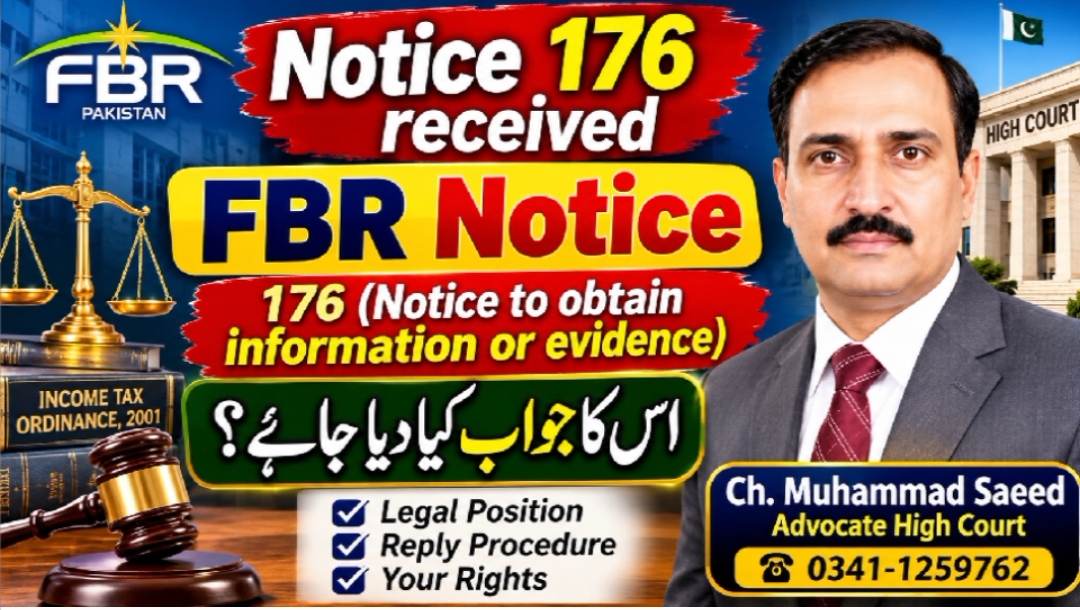
By Ch. Muhammad Saeed, Advocate High Court
Introduction
Receiving a notice from the Federal Board of Revenue (FBR) can be stressful, and Notice 176 is no exception. Many taxpayers worry about how to reply, when to reply, and whether the notice could lead to a penalty. This article explains what a Notice 176 actually is, what it is not, and the steps to follow when responding to it. It also highlights the common mistakes that taxpayers and tax practitioners make while replying. Whether you are a taxpayer who has received the notice or a professional who handles such matters for clients, this guide will help you understand how to approach the response in a careful and professional manner.
What Is Notice 176?
Notice 176 relates to the powers of the FBR to require information. These powers allow the FBR to ask a taxpayer for information on a particular matter or point. In simple terms, it is a “Demand for Call of Documents” notice: the FBR may demand documents from you.
What Notice 176 Is Not
It is important to understand that Notice 176 is:
- Not an assessment.
- Not a demand for tax.
- Not a penalty of any kind.
It is a request for information or documents, nothing more.
Steps to Take When Responding
Step 1: Check the Due Date
The first thing to do is to check the due date mentioned in the notice, and respond accordingly. If the due date is close and you have little time, there is no need to panic.
Step 2: Consider Filing an Adjournment
The simplest approach when time is short is to file an adjournment. In plain terms, an adjournment means asking the FBR for more time so that you can submit a proper reply.
The reasoning is straightforward: submitting a correct reply is better than submitting a wrong one. A wrong reply can be more dangerous than no reply at all, because once a reply has been submitted it cannot be recalled, as the information has already gone to the department.
How to file an adjournment on IRIS: Log in to IRIS and view the notice you have received. In the Assignment tab, you will find an option. Click “Adjournment Required” to obtain the adjournment.
Step 3: Examine the Jurisdiction
Next, consider the jurisdiction of the officer who issued the notice. Ask yourself:
- Does this officer have the power to issue a Notice 176 to you?
- Is the officer actually your relevant assessing officer?
Step 4: Verify the Notice on IRIS
Check whether you have received the notice on IRIS. Review the barcode and other details both on IRIS and on the physical copy. If the notice reached you physically, re-verify on IRIS that the notice is also available there.
Step 5: Attach a Power of Attorney
This is a point where tax practitioners often make a mistake. If you are responding on behalf of a client, whether to Notice 176 or any other FBR notice, have the client sign a Power of Attorney and attach it to the response. Without a Power of Attorney, the response may be treated as invalid.
Step 6: Understand the Legal Position of the Taxpayer
The response to a notice, and the whole taxation system, also depends on the status of the individual. Consider questions such as:
- Is the taxpayer a salaried individual, a non-resident, or a business individual?
- Does the income fall under exempt income, final discharge, or the normal tax regime?
Keep these points in mind while drafting the response.
Legal Points First, Then Factual Points
The points discussed above are the legal points. In any response, cover the legal points first. After that, move to the factual points relating to what the notice actually asks.
A legal argument alone does not defend your case. If the notice asks for specific items, such as bank statements or payroll slips, you should provide those documents as well.
Do Not Provide Extra Information or Documents
One rule must be remembered in every notice case: do not give extra information and do not give extra documents.
For example, if the notice asks about one particular transaction in your bank statement, provide only the document page relating to that transaction. There is no need to provide the remaining pages. In short, no extra information and no extra documents.
What the High Court and Supreme Court Have Said
There are several judgments of the High Court and the Supreme Court in favour of taxpayers on this subject. These judgments have concluded that a Notice 176 is not a fishing exercise. It is not an inquiry through which a taxpayer can be probed and questioned without limit. The notice is meant for obtaining information, or for calling a document that is needed. Beyond that, fishing cannot be done through it.
Another point is jurisdiction. A lack of jurisdiction can render the notice null and void, which is why jurisdiction must always be checked.
Common Mistakes to Avoid
Taxpayers and practitioners commonly make the following mistakes while responding:
- Replying late.
- Using emotional language.
- Admitting that a mistake was made. Do not make any such admission.
- Submitting a response without a Power of Attorney.
- Oversharing data.
Frequently Asked Questions
Question: What is Notice 176? Answer: It is a notice relating to the powers of the FBR to require information from a taxpayer on a particular matter. It is described as a “Demand for Call of Documents.”
Question: Is Notice 176 an assessment, a tax demand, or a penalty? Answer: No. It is not an assessment, not a demand for tax, and not a penalty of any kind.
Question: What should I do if the due date is close? Answer: Do not panic. The simplest approach is to file an adjournment, which means asking the FBR for time so that a proper reply can be submitted.
Question: How do I file an adjournment? Answer: Log in to IRIS, view the notice, go to the Assignment tab, and click “Adjournment Required.”
Question: Why is submitting a wrong reply risky? Answer: A wrong reply can be more dangerous than no reply, because once submitted it cannot be recalled. The information has already reached the department.
Question: Do I need a Power of Attorney if I reply for a client? Answer: Yes. When responding on behalf of a client, a Power of Attorney signed by the client should be attached. Without it, the response may be treated as invalid.
Question: How many documents should I provide? Answer: Only what has been asked. For example, if one bank transaction is questioned, provide only the page relating to that transaction. Do not give extra information or extra documents.
Question: Can Notice 176 be used for fishing? Answer: According to the High Court and Supreme Court judgments mentioned in the source, no. The notice is for obtaining information or calling a needed document, not for fishing or open-ended inquiry.
Conclusion
Notice 176 is a request for information or documents, and it is not an assessment, a tax demand, or a penalty. A careful response begins with checking the due date, seeking an adjournment if time is short, verifying the officer’s jurisdiction, confirming that the notice appears on IRIS, and attaching a Power of Attorney when replying for a client. The reply should cover the legal points first and the factual points next, and it should contain only the information and documents that were asked for. Avoid late replies, emotional language, admissions of mistake, and oversharing of data. According to the source, a professionally drafted response can allow the notice to be closed easily.
Call to Action
If you found this article useful, read our other tax and legal articles, follow our YouTube channel, and share your questions in the comments. Your questions may be answered in future videos. For further information, you may contact the professional team below.
About the Author
Ch. Muhammad Saeed, Advocate High Court Senior Member High Court Bar Association Lahore Phone: 0341-1259762 Email: msaeedadv86@gmail.com
He leads an association of lawyers, chartered accountants, computer engineers, and AI experts, providing services in property disputes and other legal matters, Income Tax, Sales Tax, Company Registration, NTN Registration, refund claims, and SECP and FBR matters.