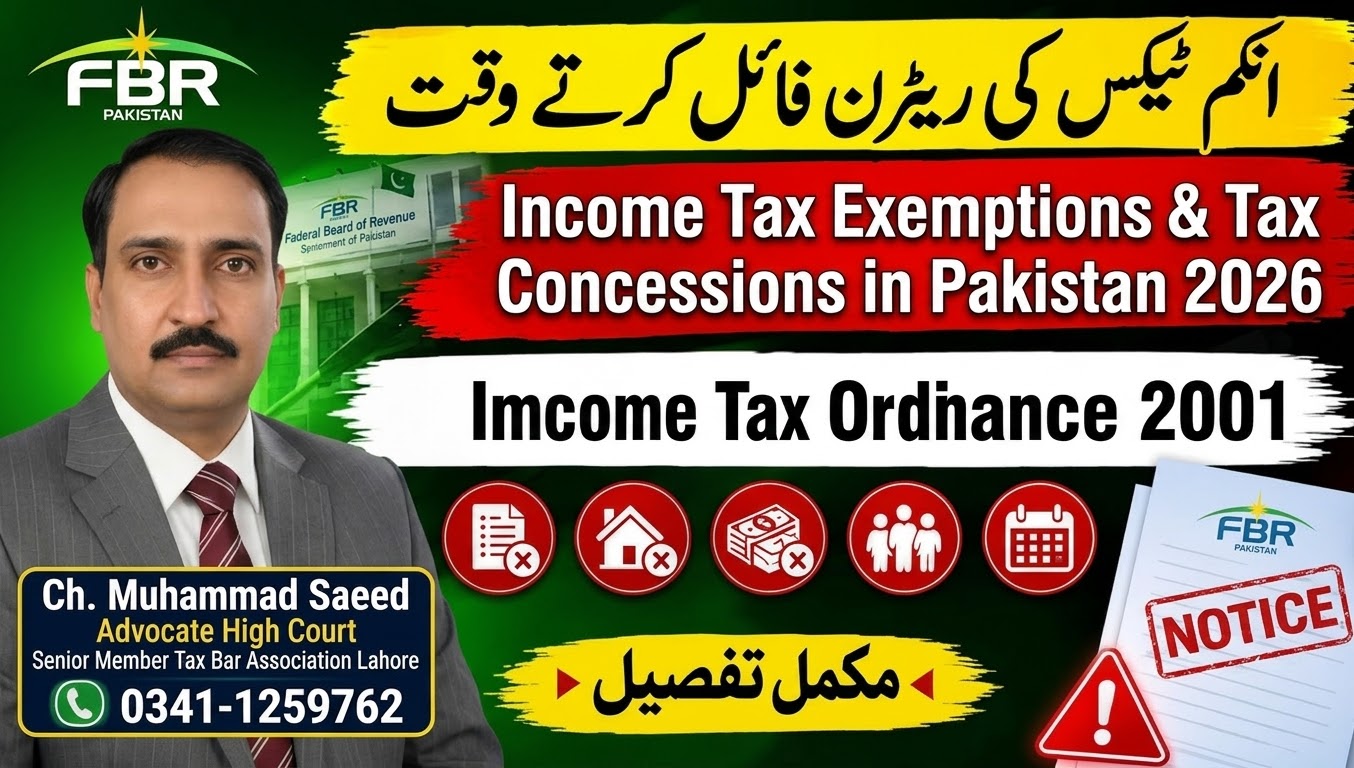
Learn how exemptions and tax concessions work under Sections 41 to 55 of the Income Tax Ordinance, including agricultural income, foreign source income, and special provisions.
- Section 41 Income Tax Ordinance
- Agricultural income tax exemption Pakistan
- Foreign source income tax relief
- Section 53 Second Schedule tax exemptions
- Section 54 Income Tax Ordinance override
- Section 55 limitation on tax relief
- Diplomat tax exemption Pakistan
- Tax concessions in Pakistan
Taxation laws provide specific reliefs to taxpayers through exemptions and concessions. Under Pakistan’s federal income tax legislation—the Income Tax Ordinance—an entire chapter comprising Sections 41 to 55 is dedicated to defining these tax reliefs, specifying who qualifies for them, and outlining the conditions under which they apply.
Navigating these legal provisions is essential for taxpayers, business owners, professionals, students, and the general public. Understanding how exemptions and concessions function helps individuals and organizations recognize which incomes are legally protected from federal taxation and how special tax reductions are administered under the law.
Defining Exemption and Tax Concession
Before examining the specific statutory sections, it is important to distinguish between a tax exemption and a tax concession:
- Tax Exemption: Refers to income or persons that are completely free from income tax liability. Although such income might otherwise be legally taxable, the law specifically grants an immunity or protection so that no tax is collected on it.
- Tax Concession: Refers to a reduction in the standard tax rate or tax liability. Instead of paying the full actual amount owed (for example, Rs. 100), the taxpayer is granted a concession to pay a reduced amount (such as Rs. 50).
Key Provisions Under Sections 41 to 55
Section 41: Agricultural Income Exemption
Under Section 41, agricultural income is completely exempt from federal income tax. Because the Income Tax Ordinance is a federal statute, federal law grants full exemption on agricultural income. However, agricultural income remains subject to taxation at the provincial level across Punjab, Sindh, Balochistan, and Khyber Pakhtunkhwa (KPK).
Exemptions for Diplomats, Foreign Officials, and International Agreements
Tax exemptions are extended to foreign diplomats, ambassadors, and officials belonging to the United Nations working in Pakistan. Foreign government employees operating in Pakistan are also exempt, provided reciprocity is evaluated—meaning it is considered whether Pakistani government officials receive similar tax relief in that foreign nation (e.g., the UK).
Furthermore, tax exemptions apply when established under bilateral or multilateral international agreements made by Pakistan. Foreign workers’ salaries are exempt from tax if they are working under aid programs funded by entities such as:
- The United States
- The United Nations
- The World Bank
- The Asian Development Bank (ADB)
Individuals working on foreign-funded projects also enjoy tax exemption status.
Foreign Investments and Non-Resident Profits
Foreign investments entering Pakistan, along with foreign investors and shareholders, qualify for tax exemptions under these provisions.
Additionally, if a non-resident individual earns a profit on a debt or security issued by a Pakistani entity, that profit earned by the non-resident is tax-free.
Presidential Awards, Scholarships, and Support Payments
Specific personal payments and recognitions are granted full federal tax exemption:
- Presidential Awards: Monetary awards, cash prizes, or allowances accompanying presidential honors (such as Tamgha-e-Imtiaz, Tamgha-e-Hilal, Jurrat, etc.) are tax-free.
- Scholarships: All educational scholarship payments are exempt from tax.
- Support Payments: Financial support payments provided under a formal agreement between living-apart spouses are exempt from tax.
Government Income
Incomes earned by the Federal Government, Provincial Governments, or Local Governments are exempt from income tax. However, if a government entity engages in a business or earns income outside its designated legal jurisdiction or scope, that income becomes subject to tax.
Foreign Source Income and Temporary Residents
Special rules govern foreign source income for individuals temporarily residing in Pakistan:
- Temporary Residents: If a foreign-based individual (e.g., a Pakistani residing in the UK) comes to Pakistan temporarily for a year or two, their UK-sourced salary is not taxable in Pakistan. The maximum threshold to be considered temporary under this provision is up to three years; residing for three years or more removes the temporary status.
- Returning Citizens: If a Pakistani citizen returns to Pakistan after residing abroad for four or more consecutive years, their foreign source income is exempt from tax for the year of their arrival and the subsequent tax year.
Section 53: The Second Schedule and Executive Powers
Section 53 sets out the specific framework for granting full tax exemptions, reduced tax rates, tax liability concessions, or procedural exemptions listed in the Second Schedule of the Income Tax Ordinance.
- List of Beneficiaries: Section 53 references a comprehensive list in the Second Schedule specifying which persons, classes of persons, or specific types of income qualify for complete exemptions or discounted rates.
- Government and FBR Powers: The Federal Government or the Federal Board of Revenue (FBR), subject to proper approval, holds the authority to amend the Second Schedule to add, modify, increase, or decrease tax concessions.
- Grounds for Amendment: Amendments to exemptions and concessions under Section 53 are typically introduced for reasons of national security, natural disasters, food security, economic protection, or international obligations (such as bilateral defense or investment agreements).
- Parliamentary Approval: All such amendments must be presented before the Parliament (National Assembly) for official approval.
Section 54: Overriding Effect of the Ordinance
Section 54 establishes that any tax exemption, reduction, or special tax treatment granted under any other law will not be legally recognized unless provided under the Income Tax Ordinance.
Because the Income Tax Ordinance is the primary federal law governing income taxation, its provisions override all other statutes in matters of income tax exemptions and concessions.
Section 55: Limitation on Transferring Tax Relief
Section 55 outlines strict limitations regarding the transferability of tax concessions and exemptions:
- First-Hand Relief Only: Tax relief, exemptions, or concessions are granted strictly to the original (first-hand) recipient.
- Non-Transferability: If a person receives a tax-exempt item, gift, or income and subsequently transfers or sells it to another person, the secondary recipient cannot claim the tax exemption. The second recipient must pay applicable taxes on that transaction or item.
Frequently Asked Questions
Question: Is agricultural income completely tax-free in Pakistan? Answer: Agricultural income is exempt from federal income tax under Section 41 of the Income Tax Ordinance. However, it is subject to taxation under provincial laws in Punjab, Sindh, Balochistan, and Khyber Pakhtunkhwa.
Question: Are foreign workers on aid projects subject to income tax in Pakistan? Answer: Foreign workers earning salaries under foreign-funded aid programs or projects supported by organizations such as the UN, World Bank, Asian Development Bank, or foreign governments are exempt from income tax.
Question: How is foreign source income taxed for returning overseas Pakistanis? Answer: If a Pakistani citizen returns to Pakistan after living abroad for four or more years, their foreign source income is exempt from tax for the tax year in which they return and the following tax year.
Question: Can tax exemptions be granted through other non-tax laws in Pakistan? Answer: No. Under Section 54, the Income Tax Ordinance overrides all other laws regarding income tax. Exemptions or reductions granted under other statutes are not legally recognized for income tax purposes unless provided under the Ordinance.
Question: Can a person transfer a tax-exempt gift to someone else while retaining the tax-free status? Answer: No. Under Section 55, tax concessions and exemptions apply only to the first-hand recipient. Once transferred or sold to a secondary recipient, the exemption no longer applies, and applicable taxes must be paid.
Question: Who has the authority to amend the Second Schedule for tax concessions? Answer: Under Section 53, the Federal Government or FBR (with proper approval) can amend the Second Schedule, subject to approval from the Parliament (National Assembly).
Conclusion
Sections 41 through 55 of the Income Tax Ordinance establish a clear statutory structure governing tax exemptions and concessions in Pakistan. From federal protections on agricultural income and diplomatic immunities to executive powers under Section 53 and transfer limitations under Section 55, these provisions balance economic protection, international obligations, and federal legal authority.
Need Legal & Taxation Assistance?
For professional guidance on income tax, sales tax, property disputes, and corporate compliance, reach out to our expert legal and consultancy association.
Ch. Muhammad Saeed, Advocate High Court Senior Member, High Court Bar Association Lahore
Our Association Includes:
- Lawyers
- Chartered Accountants
- Computer Engineers
- AI Experts
Services Provided:
- All legal matters regarding property disputes
- Income Tax & Sales Tax
- Company Registration & SECP Matters
- NTN Registration & FBR Matters
- Refund Claims
Contact Information:
- Phone: 0341-1259762
- Email: msaeedadv86@gmail.com
Sponsors interested in promoting their products or services are also welcome to contact us.