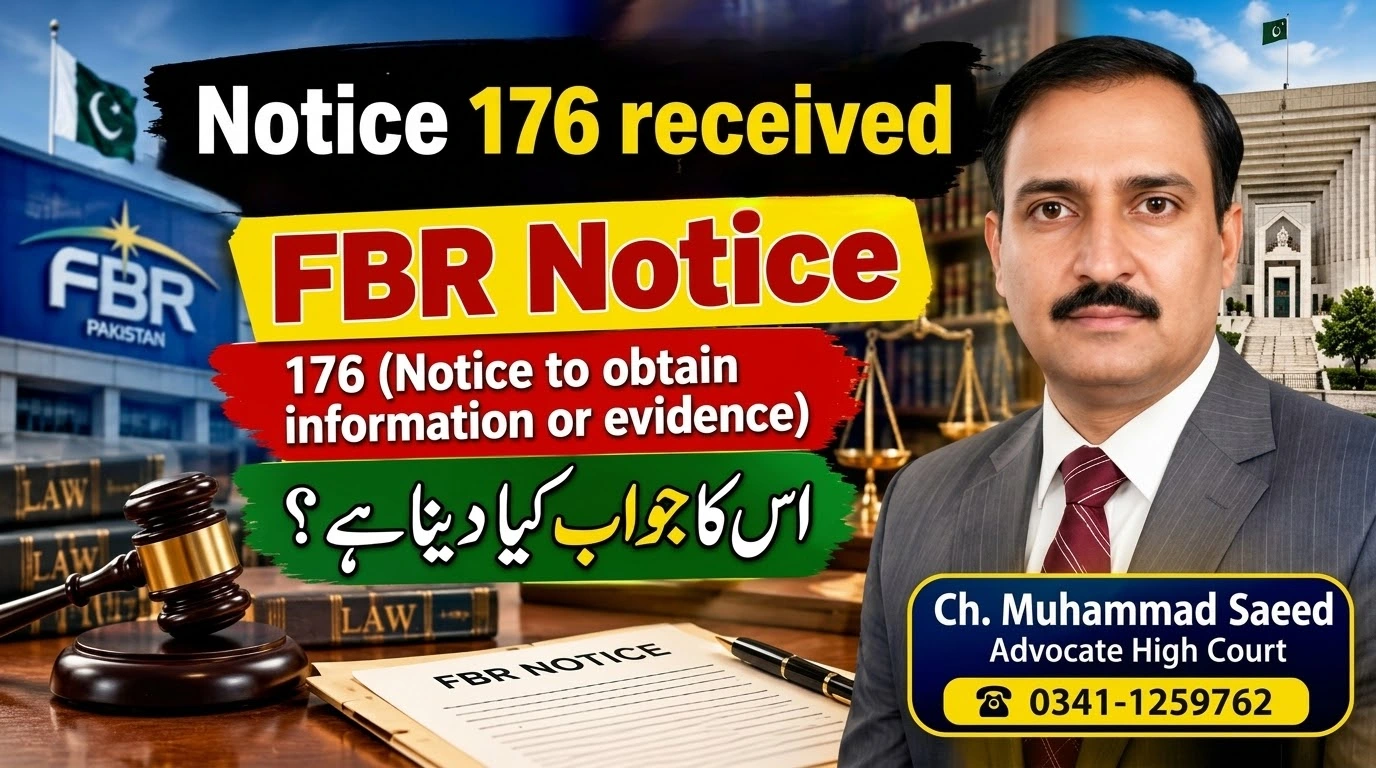
Received an FBR Notice 176? Learn what Section 176 means, how to respond, step-by-step procedures, key legal protections, and common mistakes to avoid.
Introduction
Receiving a notice from the Federal Board of Revenue (FBR) can cause significant worry and confusion for taxpayers. Among the various notices issued by tax authorities, Notice 176 is particularly common. Many taxpayers immediately fear that receiving this notice means an assessment has been finalized, tax demands have been created, or financial penalties have been imposed.
However, understanding the exact nature and purpose of Section 176 can help alleviate unnecessary panic. This notice is simply a formal call for information and documents, rather than an immediate tax assessment or penalty. This comprehensive guide outlines what an FBR Notice 176 represents, the step-by-step procedure to respond effectively, key legal protections available to taxpayers under High Court and Supreme Court rulings, and critical mistakes you must avoid when submitting your response.
What Is an FBR Notice 176?
An FBR Notice 176 is primarily a demand for the call of documents and information. Under Section 176, the tax department is granted powers to require specific information or documentation from a taxpayer regarding a particular matter.
What Notice 176 Is NOT:
To handle this notice correctly, it is essential to understand what it does not represent:
- Not an Assessment: Notice 176 does not constitute a tax assessment.
- Not a Tax Demand: It does not create an immediate monetary or tax liability demand.
- Not a Penalty: It is not a penalty or fine levied against you.
In simple terms, it is an administrative mechanism used by the FBR to request necessary documents or clarification regarding specific matters.
Step-by-Step Response Procedure
When responding to an FBR Notice 176, following a structured and cautious approach ensures that your legal standing remains protected.
Step 1: Check the Due Date and Request an Adjournment if Needed
The first action you must take upon receiving the notice is to verify the specified due date.
- Avoid Panicking: If the due date is near and time is short, do not panic.
- File an Adjournment Application: Submitting a correct response takes time. Filing an adjournment request to ask the FBR for additional time is far better than submitting an incorrect or rushed reply.
- Why Adjournment Matters: Submitting an incorrect response is often more dangerous than failing to submit one immediately. Once a reply containing specific information is submitted, it cannot be recalled because the information has already reached the authorities.
- How to File an Adjournment: Log in to the IRIS portal, view the received notice, navigate to the assignment tab, and click on the option to request an adjournment.
Step 2: Verify Jurisdiction and Notice Authenticity
Before drafting any reply, examine the legal validity and source of the notice:
- Check Jurisdiction: Verify whether the issuing officer possesses the legal power and jurisdiction to issue a Section 176 notice to you, and whether they are your relevant assessing officer.
- Re-Verify on IRIS: Confirm that the notice appears on your official IRIS portal. Check the barcode and all notice details online. Even if you receive a physical notice, always re-verify its existence and details directly on the IRIS portal.
Step 3: Attach a Signed Power of Attorney
A common mistake made during the response process—even by tax practitioners—is failing to attach a valid Power of Attorney (Wakalatnama).
- If a tax practitioner, lawyer, or consultant responds to a notice on behalf of a client, a signed Power of Attorney from the client must be attached.
- Without a proper Power of Attorney, any response submitted on behalf of the client can be treated as legally invalid.
Step 4: Determine Your Legal Position
Your response must be tailored according to your specific tax status and legal standing under the taxation system. Consider whether you are a:
- Salaried individual
- Business individual
- Non-resident taxpayer
Additionally, determine how your income is categorized—whether it falls under exempt income, final discharge regime, or the normal tax regime.
Structuring Your Response: Legal vs. Factual Points
A well-drafted response to an FBR Notice 176 should be divided logically into two primary segments:
1. Legal Points First
Always address legal arguments at the beginning of your reply. This includes establishing your status, questioning jurisdiction (if applicable), and outlining relevant statutory provisions.
2. Factual Points Second
Relying solely on legal arguments is insufficient to defend your case. You must also address the specific factual questions raised in the notice by providing required documentation, such as bank statements or payroll slips.
The Rule Against Over-Sharing Data
When submitting factual evidence, strictly observe the following rules:
- No Extra Information: Provide only what has been explicitly requested.
- No Extra Documents: Do not submit unnecessary records or complete sets of books unless asked.
- Specific Evidence Only: For example, if the notice inquires about a specific transaction within a bank statement, provide only the page containing that particular transaction rather than submitting entire unrequested bank records.
Important Court Judgments and Legal Rights
High Court and Supreme Court judgments have established strong legal protections for taxpayers regarding Section 176 notices:
- No Unrestricted “Fishing” or Inquiries: Superior court decisions have concluded that a Notice 176 cannot be used as a fishing expedition or an open-ended inquiry to dig into a taxpayer’s affairs arbitrarily. It is strictly limited to calling for specific documents or information.
- Lack of Jurisdiction Invalidates Notices: If the issuing officer lacks proper jurisdiction, the notice becomes legally void (null and void).
Common Mistakes to Avoid When Replying
Taxpayers and representatives often make critical errors that complicate their cases. Ensure you avoid the following:
- Late Replies: Failing to respond or request an adjournment within the given timeframe.
- Using Emotional Language: Drafting responses based on emotion rather than objective legal and factual grounds.
- Admitting Mistakes Unnecessarily: Making premature admissions of error in written submissions.
- Omitting Power of Attorney: Submitting replies on behalf of clients without an attached, signed Power of Attorney.
- Over-Sharing Data: Providing excessive documentation and extra information beyond the scope of the notice.
By drafting a response professionally, keeping it limited to required facts, and addressing key legal aspects, an FBR Notice 176 can be resolved easily without further complications.
Frequently Asked Questions
Question 1: Is receiving an FBR Notice 176 an indicator of a tax penalty or assessment?
Answer: No. An FBR Notice 176 is neither an assessment nor a tax demand, nor is it a penalty. It is strictly a formal notice calling for specific documents or information.
Question 2: What should I do if the deadline for responding to Notice 176 is very close?
Answer: If time is limited, you should file an adjournment application through the IRIS portal to request additional time from the FBR. This prevents you from making mistakes in a rushed reply.
Question 3: How can I file an adjournment request for an FBR notice?
Answer: Log in to your IRIS account, open the specific notice under the view option, navigate to the assignment tab, and select the option to request an adjournment.
Question 4: Why is it important to attach a Power of Attorney when replying to FBR?
Answer: If you are responding on behalf of a client, failing to attach a signed Power of Attorney can render the response legally invalid.
Question 5: Can the FBR use Notice 176 to conduct broad inquiries or “fishing” into my records?
Answer: No. Multiple High Court and Supreme Court judgments have affirmed that Section 176 cannot be used for open-ended “fishing” or arbitrary inquiries; it is limited to calling for specific required documents or information.
Conclusion
An FBR Notice 176 is an administrative tool used by tax authorities to request specific information or documentation. It does not mean you have been penalized or assessed with a tax liability. By taking systematic steps—verifying notice authenticity on IRIS, checking jurisdiction, seeking an adjournment if necessary, attaching a Power of Attorney, framing both legal and factual points accurately, and avoiding over-sharing of data—you can resolve the notice smoothly. Seeking professional assistance ensures your reply is drafted correctly and your legal rights remain protected.
If you require professional services or assistance in drafting a formal response, you can reach out to Dwer Associates via email. Stay connected for more informative legal and tax updates, and feel free to leave your questions in the comments section below.
Professional Contact Information
Ch. Muhammad Saeed, Advocate High Court Senior Member High Court Bar Association Lahore
We are an association comprised of:
- Lawyers
- Chartered Accountants
- Computer Engineers
- AI Experts
Services Provided:
- All legal matters regarding property disputes
- Income Tax
- Sales Tax
- Company Registration
- NTN Registration
- Refund claims
- SECP & FBR matters
Phone: 0341-1259762 Email: msaeedadv86@gmail.com