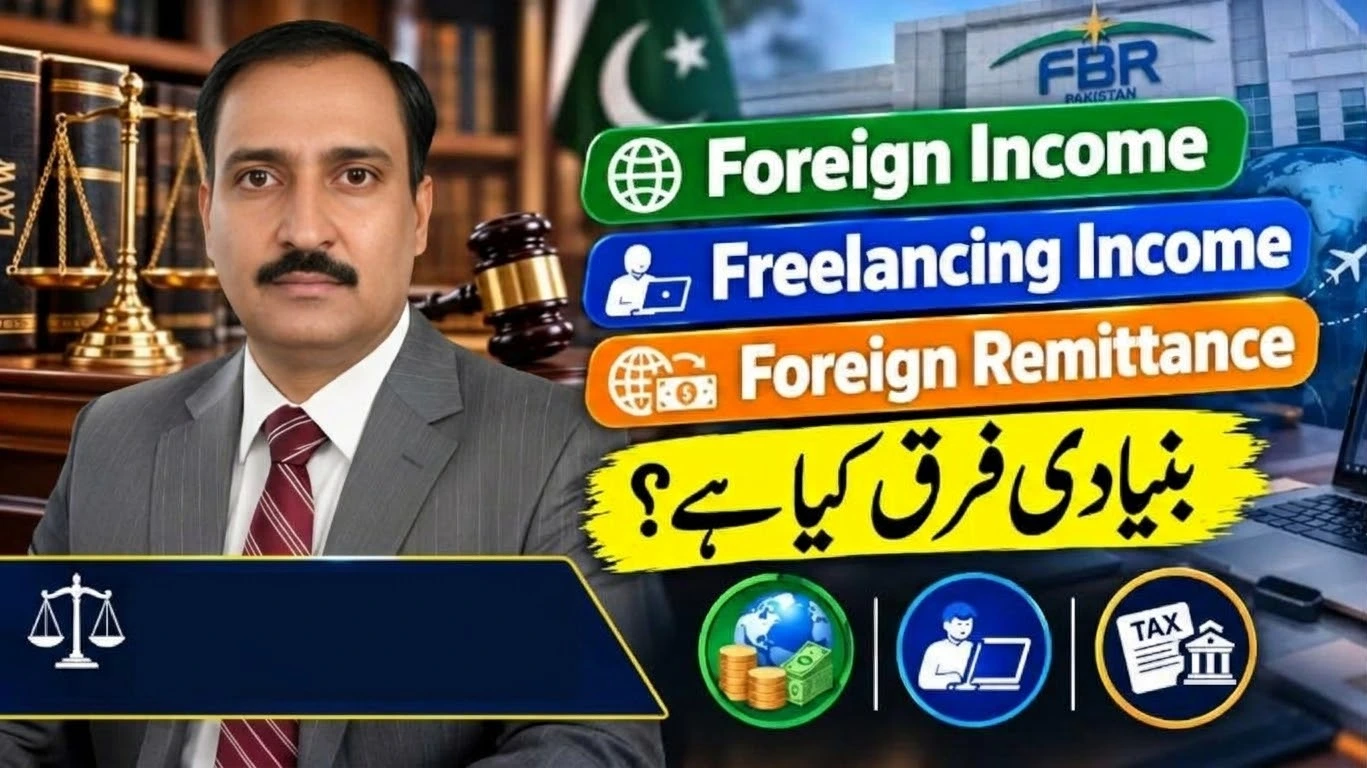
Learn the difference between home remittance and freelance or IT service payments in Pakistan, FBR tax rates under Section 111(4) and Section 154, and key compliance requirements.
Introduction
In Pakistan, freelancers and service providers often face confusion regarding foreign income classification. A common misconception is treating payments for foreign clients or IT services as home remittances. Misclassifying service receipts as remittances can result in significant legal and tax troubles with the Federal Board of Revenue (FBR) and other regulatory bodies.
Understanding the difference between home remittances and business or service receipts is vital to avoiding legal disputes, tax penalties, and audits. This comprehensive guide details the definition of home remittances under Income Tax Ordinance Section 111(4), the actual tax obligations for business and IT service receipts, recent FBR tax return updates, and actionable steps to keep your income legal and fully compliant.
What Is Home Remittance?
Home remittance has a specific legal definition under Pakistani law. It refers strictly to money sent back to Pakistan by an individual working abroad who has already paid taxes in that foreign country, meant to support their family or cover personal household expenses.
Key Aspects of Home Remittance:
- Definition: Funds sent by individuals working abroad to support family expenses.
- Section 111(4) Relief: Under Section 111, sub-section 4 of the Income Tax Ordinance, foreign funds received up to PKR 50 lakh (5 million PKR) are exempt from being treated as concealed or unclean income.
- No Unexplained Tax Probes (up to limit): FBR will not question the origin of funds as concealed income if the amount remains at or below PKR 50 lakh.
- Basis of the PKR 50 Lakh Limit: This ceiling accounts for average annual family expenses (roughly calculated at PKR 4 lakh to 5 lakh monthly).
Misuse of Remittances and Recent FBR Strictness
A widespread error among service providers and freelancers is requesting foreign clients to label service payments as “home remittance” or withdrawing foreign payments through banks without paying applicable tax. This practice has become a form of misuse, historically used by some to convert black money into white income.
To curb this misuse, the FBR and regulatory authorities have introduced strict monitoring measures:
- Tax Return Sender Particulars: For the first time, taxpayers must disclose the sender’s details and their exact relationship to the sender in their income tax returns.
- Proving Relationships: If a foreign sender named David transfers funds to a receiver named Abraham, the taxpayer must legally prove their relationship.
- Imperfect Sender Matching: Failing to substantiate a familial or personal relationship can invite FBR scrutiny and inquiries.
- Future Caps & Restrictions: Authorities are moving toward stricter capping and tighter rules on remittances, requiring taxpayers to prove sender identities and relationships.
Tax Rates & Reliefs for Freelance, Business, and IT Services
If you perform work or render services for foreign clients and receive payments, those funds are classified as business receipts, not remittances. The Pakistani government provides substantial tax reliefs to encourage legitimate foreign business inflows.
| Receipt Category | Applicable Law / Tax Provision | Applicable Tax Rate | Validity / Extension |
|---|---|---|---|
| Normal Foreign Services | Section 154 | 1% Tax | Standard Rule |
| IT & IT-Related Services | Promotional IT Tax Relief | 0.25% Tax (25 Paise) | Extended from 2026 to 2029 (3-year extension) |
Benefits of Correct Service Income Reporting:
- Nominal Tax Rates: Paying a low tax rate (as low as 0.25% for IT services or 1% for normal services) converts foreign income into completely legal, white consideration.
- Global Advantage: These tax rates represent some of the lowest foreign income tax rates worldwide.
- Legal Shield: Proper tax deduction at source protects taxpayers from tax audits, general orders, and SRO-based inquiries.
Regulatory Oversight Beyond FBR
Accepting home remittances for IT or export services instead of paying nominal service taxes creates severe long-term complications. Monitoring is not restricted solely to the FBR.
Foreign exchange receipts are closely monitored by multiple authorities:
- State Bank of Pakistan (SBP)
- Anti-Money Laundering (AML) Agencies
- Intelligence Bureau (IB)
- National Investigation Agency (NIA) / Intelligence Agencies
In the event of a FBR General Order or SRO amendment, inquiries can be launched into historical foreign transfers that lack proper service taxonomy or source verification.
The Common Mistake of Local Income Distribution
Another frequent mistake occurs when a group of two or three people work together on a project, receive foreign payments into a single team member’s bank account, and subsequently transfer shares locally to the other team members’ accounts.
Crucial Rule on Money Fate: Money’s legal status is determined at the very first account where the foreign money drops. Local bank-to-bank transfers never count as foreign receipts or IT receipts for the secondary recipients.
For income to be considered legally verified foreign income, tax must be properly deducted upon entry into the primary receiving account.
How to Make Your Foreign Income Fully Legal and Compliant
To avoid future legal troubles, foreign exchange scrutiny, or FBR inquiries, follow these steps:
- Obtain an NTN: Register with the FBR and get your National Tax Number (NTN).
- Open a Business Bank Account: Set up a designated business account with your bank rather than receiving payments in a basic personal account.
- Instruct Foreign Clients: Clearly inform senders to mark payments as service receipts or business payments, not personal remittances.
- Inform Your Bank: Clear explicit instructions must be given to your bank that incoming funds are service/IT income, enabling them to deduct the applicable tax (e.g., 0.25% or 1%).
- Declare Correctly in Returns: Record sender details and income streams accurately in annual tax returns.
Following these procedures ensures your foreign income is completely white, fully legal, and worry-free.
Frequently Asked Questions (FAQs)
Q1: Is foreign money received for freelancing considered home remittance?
Answer: No. Money received for work or services rendered to foreign clients is a business or service receipt, not a home remittance.
Q2: What is the threshold for home remittance protection under Section 111(4)?
Answer: Under Section 111(4) of the Income Tax Ordinance, foreign funds up to PKR 50 lakh (50,000,000 PKR) received as home remittance are exempt from being questioned as concealed income.
Q3: What are the tax rates for foreign service receipts in Pakistan?
Answer: Normal services are subject to a 1% tax rate under Section 154. IT and IT-related services enjoy a promotional nominal tax rate of 0.25% (25 paise).
Q4: How long is the promotional tax relief for IT services valid?
Answer: The promotional tax relief for IT services, which was originally set to end in 2026, has been extended for three years until 2029.
Q5: Can local money transfers from a colleague’s account count as foreign IT receipts?
Answer: No. Local bank transfers are not recognized as foreign or IT receipts. The tax treatment and legal status of foreign money are established at the initial bank account into which the funds first drop.
Q6: What new information does the FBR require in tax returns regarding remittances?
Answer: The FBR requires taxpayers to provide the foreign sender’s particulars and disclose the taxpayer’s relationship to the sender in their tax returns.
Q7: Which agencies monitor foreign exchange coming into Pakistan?
Answer: Foreign exchange inflows are monitored by the FBR, State Bank of Pakistan (SBP), Anti-Money Laundering agencies, Intelligence Bureau (IB), National Investigation Agency (NIA), and other intelligence agencies.
Conclusion
Confusing foreign service payments with home remittances is a risky legal mistake. While home remittances sent by overseas family members benefit from protection under Section 111(4) up to PKR 50 lakh, business and freelancing receipts must be treated as service income. Taking advantage of Pakistan’s low tax rates—1% for standard services under Section 154 and 0.25% for IT services extended through 2029—ensures your money is completely legal and white. By obtaining an NTN, operating a business account, instructing banks to deduct proper tax, and declaring sender details accurately, freelancers and professionals can easily safeguard themselves against FBR and regulatory scrutiny.
Legal & Professional Contact Information
For expert legal guidance, tax consultancy, company registration, or property dispute assistance, reach out to our team of lawyers, chartered accountants, computer engineers, and AI experts:
- Chaudhry Muhammad Saeed Advocate High Court Senior Member, High Court Bar Association Lahore
- Services Provided: Legal Matters (Property Disputes), Income Tax, Sales Tax, Company Registration, NTN Registration, Refund Claims, SECP & FBR Matters.
- Phone: 0341-1259762
- Email: msaeedadv86@gmail.com
If you found this guide helpful, feel free to like, share, and subscribe to our YouTube channel, and leave your questions in the comment section for future topic coverage.